Sold under Gross Margin Scheme
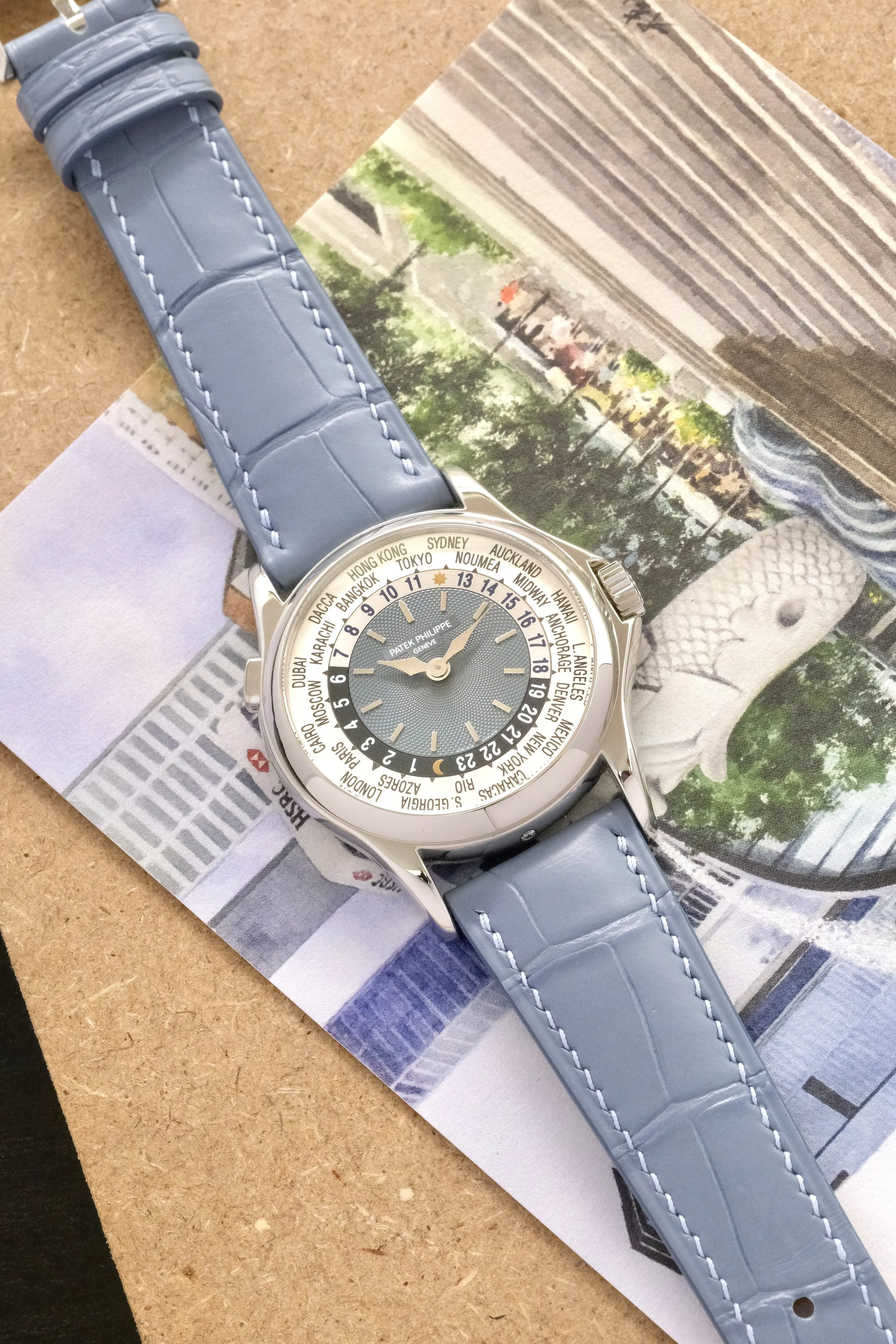
A complication invented by Louis Cottier in the 1930s with a capability to show 24 different timezone at the same time, the World Time is a Patek Philippe icon that is often overlooked.
The 5110 was launched in the year 2000, making it the first World Time watch after the legendary reference 2523 from the 1950s.
It measures at conservative 37mm in diameter with around 9mm thick in Platinum. However due to its long and slender lugs it feels bigger on the wrist.
The dial has a classic World Time layout with a 24 city-ring on the outside and at the center it has a distinct grayish blue guilloche dial center.
The 5110 is powered by the self-winding Cal. 240 HU (Heure Universelle) with micro-rotor and it comes with an easy adjuster at 10.
Sold under Gross Margin Scheme
In 2019 Vacheron Constantin did a collaboration with photographer and climber Cory Richards to prove that the Overseas is a robust watch that can be worn on an extreme adventure. Vacheron Constantin created a prototype Overseas Dual Time in Titanium that he wore to an expedition to the Mount Everest.
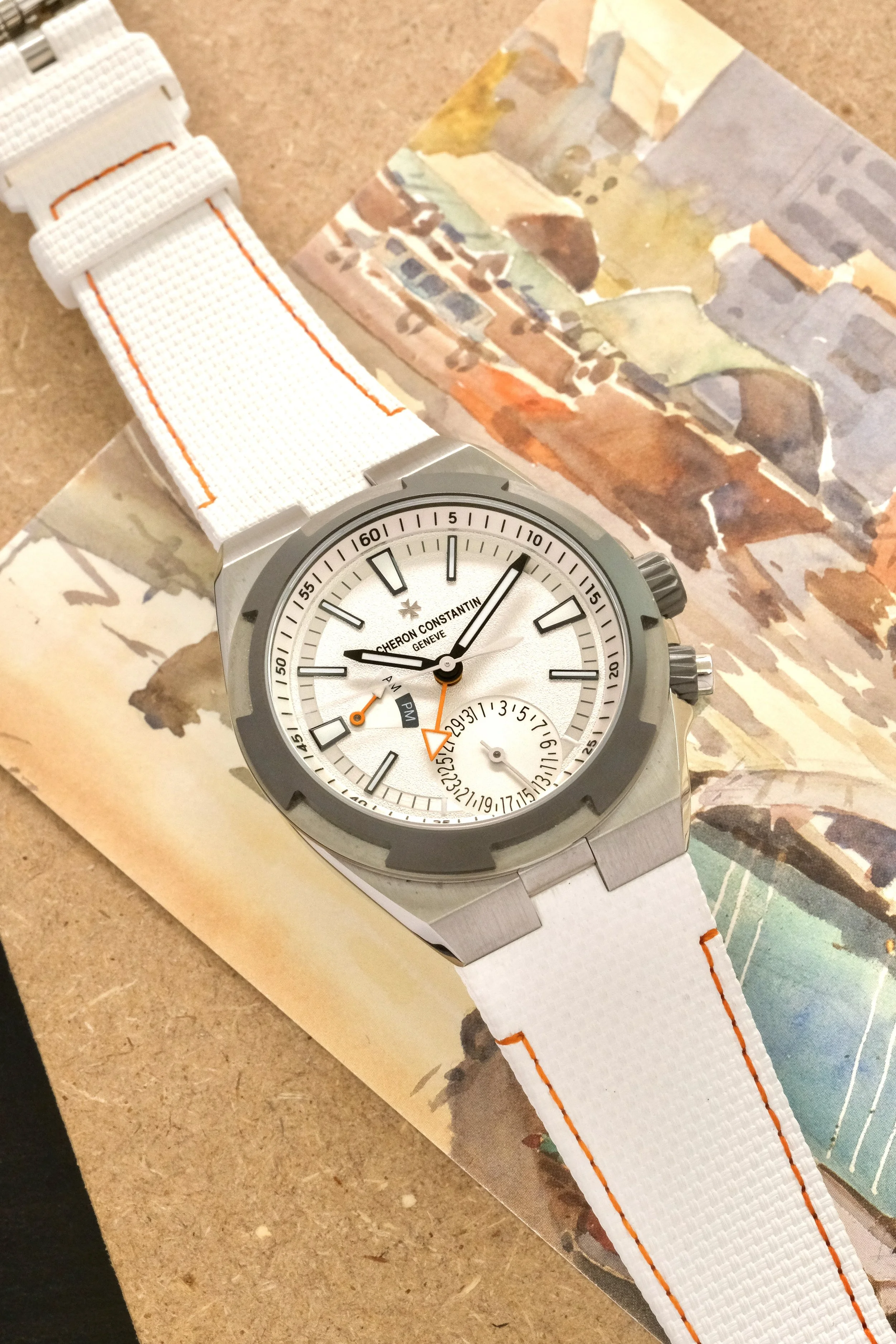
During The Watch and Wonders in 2026, Vacheron Constantin introduced the Overseas Dual Time “Cardinal Points”, a more refined version of the Prototype and the “Everest” Limited Edition with four color scheme for each of the Cardinal Points.
It features a white dial with three-different finishes grained finished center, circular satin-finished internal minute track, lacquered finish external minute track. It has a subdial at 6 indicating the date and an AM/PM indicator at 9. The hand indicating the second timezone and AM/PM are in orange giving it a sporty look as well as high legibility.
The case measures at 41mm in diameter with 12.2mm thick profile in Titanium for the lightness and durability. The Maltese Cross inspired bezel has a matte anthracite grey finish giving it a more distinct look. It also comes with a screw down pusher at 4 for the quick set date pusher. It comes with easily interchangeable rubber straps in white and orange as well as a Titanium bracelet.
Powering the Cardinal Points is the Cal. 5110 DT/3 Self-Winding movement with 60 hours power reserve and it has the Poinçon de Genève hallmark for the movement has been tested for accuracy and finish quality.
Sold under Gross Margin Scheme
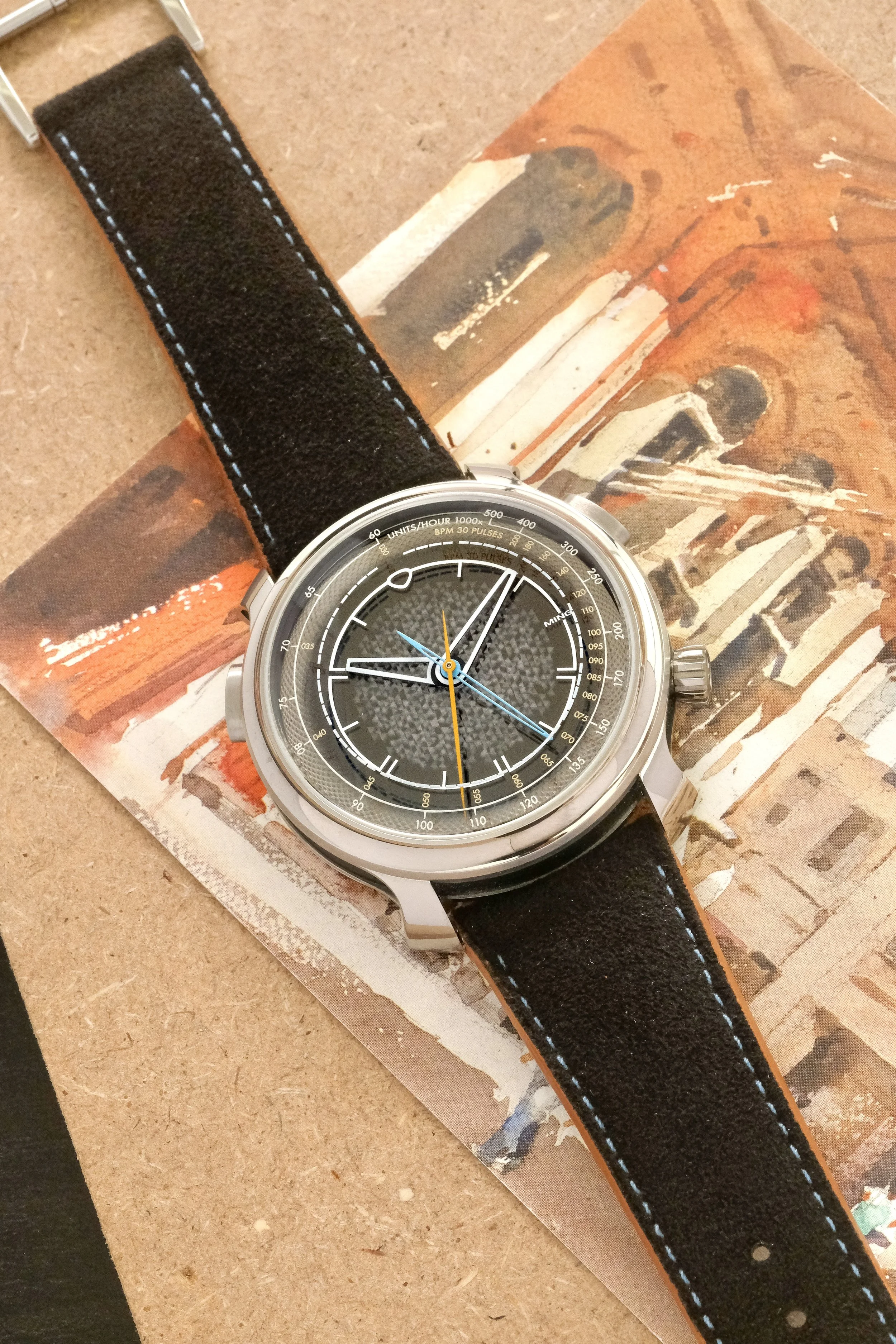
The Ming 20.01 is part of Ming's Special Project Cave, an invitation only concept where they create special pieces with high-end complication and experiment with different material and finish. The Series 1 was first introduced in 2020 as an 8-piece limited edition. It was then followed up by the Series 2 one year later, as a 50 piece limited edition.
It has an opaque Mosaic dial with tachymeter and pulsation scale. The base of the dial is made of a grade 2 titanium plate with Clous-de-Paris pattern. The Mosaic at the center of the dial consists of 3,300 triangular elements of varying sizes etched at different height and varying opacity. The scales are printed on top of the crystal to minimize parallax error. And the dials and hands are loaded with HyCeram and Super Luminova X1.
The case is made of grade 5 Titanium with a DLC coated titanium caseband. It measures at 41.5mm with 14.2mm thickness. The crown is placed at 4 to accommodate the two chronograph pusher at 10 and 2.
On the back is as spectacular if not more than the front. The Cal. 6361.M1 developed by a complication specialist Jean-Marc Wiederrecht of Agenhor. It is a hand wound chronograph with center second and minute chronograph hands. It is decorated per Ming's standard with DLC coated bridges, plates and polished steel components.
Sold under Gross Margin Scheme
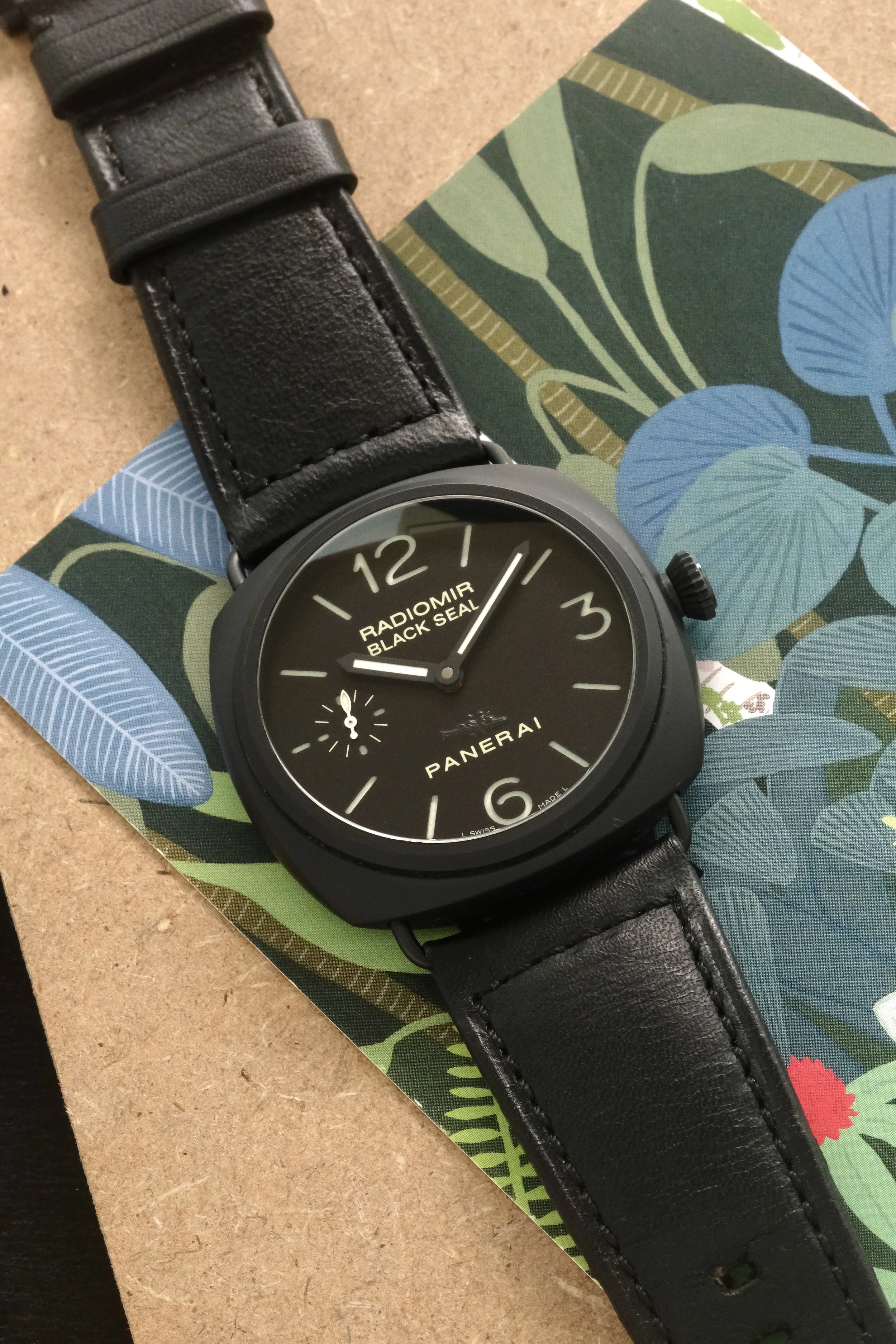
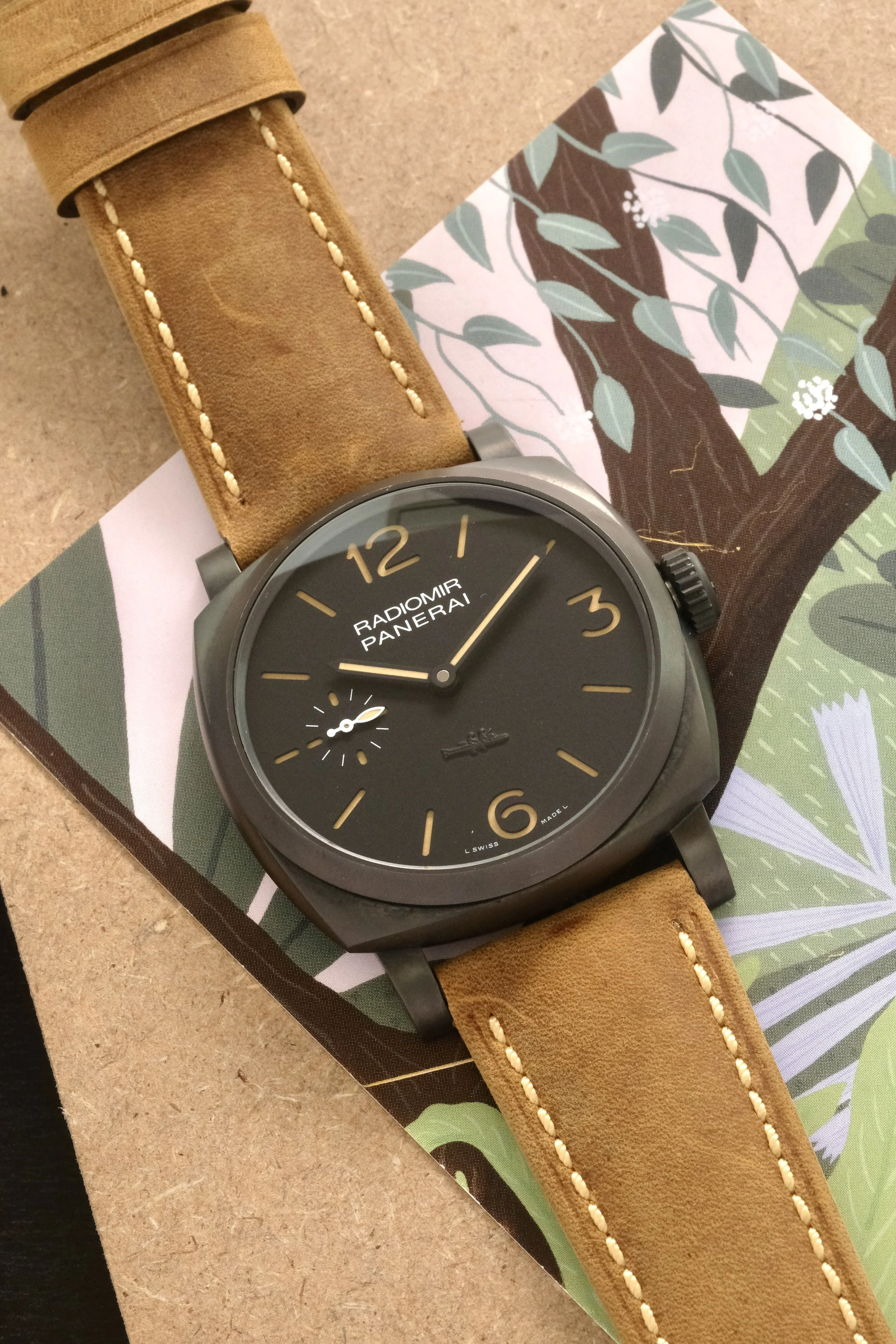
The PAM292 was first introduced in 2007 and itwas the first Panerai watch made with a lightweight matte black ceramic material giving it a durable and scratch resistant as an alternative to the that time commonly used PVD Coated Stainless Steel.
It features a Radiomir case, a cushion shaped case with wire lugs measuring at 45mm in diameter with 14.5mm thick profile. The case back is made of PVD coated stainless steel.
It is paired with a matte black sandwich dial with “Radiomir Blackseal” inscribed on the dial. Only on the first year production it features an embossed silhouette of the SLC - slow speed human torpedo used by the Italian Navy - just above the Panerai branding at 6 o’clock.
It is powered by the Cal. OP XI based on the workhorse ETA 6497-1 hand wound movement.
Sold under Gross Margin Scheme
The PAM532 was released in 2013 as a 500 piece limited edition. It is a tribute to Paneristi .com, an online community dedicated to Panerai enthusiasts that played a big part in the early success of Panerai.
It features a Radiomir 1940 case, a case transitioning from the Radiomir to Luminor case with added lugs without crown guard. It measures at 47mm with 16mm thick profile in DLC coated Stainless Steel.
It has a black sandwich dial with faux-patina colored Super LumiNova and subtly features an embossed silhouette of the Siluro a Lenta Corsa (SLC - a slow-speed human torpedo used by the Italian Navy) just above 6 o’clock.
It is powered by the in-house Cal. P.3000 hand wound movement with 3-days power reserve.
Sold under Gross Margin Scheme
The Jaeger LeCoultre Odysseus debuted in the late 1980s during a transitional era of watchmaking when the Swiss watch brands experimented with complications post quartz crisis. The Perpetual Calendar was the brand’s first modern complicated watch and modern perpetual calendar.
The platinum version was made as a 90 pieces Limited Edition measuring at 36mm in diameter with 8.5mm slim profile. The bezel and case has a curved profile and features a double-step design.
The dial is white with month and year indicator positioned at 12 o’clock, day of the week at 3 o’clock, date at 9 o’clock and moon phase indicator at 6 o’clock. There’s also a 24 hour indicator at the center of the dial that indicates when it is safe or unsafe to adjust the calendar.
It is powered by the Cal. 889/400 ultra-thin self-winding movement with a perpetual calendar module that shares the principles with IWC’s Perpetual Calendar developed by Kurt Klaus. A clever feature of this movement is the ability to adjust the calendar directly through its crown rather than individual pushers.